
Fiber vs CO2 Laser: Which One Belongs in Your Workshop?
The wavelength decides everything. A practical comparison of running cost, material range and maintenance for Indian fabricators.
It starts with the wavelength
A CO₂ laser fires at 10.6 micrometres; a fiber laser at roughly 1.07. That single number reshapes the entire economics of your cutting room. The shorter wavelength of a fiber source is absorbed far more efficiently by metals, so more of the input electricity becomes heat at the kerf and less becomes heat in your machine frame.
For mild steel, stainless and aluminium the result is faster cuts, a narrower kerf and an edge that usually needs no secondary cleaning. CO₂ still holds an edge on thick acrylic, wood, leather and paper — non-metals that a fiber beam simply passes through without absorbing.
Running cost, side by side
A 2 kW fiber resonator runs at wall-plug efficiencies above 30 percent. A 2 kW CO₂ tube sits closer to 10 percent, and the rest of that energy leaves as heat your chiller has to remove. On a two-shift schedule the electricity delta alone can pay for a service contract within a year.
CO₂ machines also consume laser gas and optics that degrade with use. Fiber sources have no mirrors to align and no gas to refill, which is why their mean time between service visits is typically two to three times longer.
Which one belongs in your shop
If 80 percent or more of your work is metal — sheet, tube or profile — a fiber cutter is the clear answer. If you cut signage, gaskets or thick acrylic alongside metal, a CO₂ (or a hybrid) may still earn its floor space.
We size both, install both and service both. The right answer is the one that matches your job queue, your floor space and your electricity budget — not the one with the bigger brochure.
Material and thickness capability, compared honestly
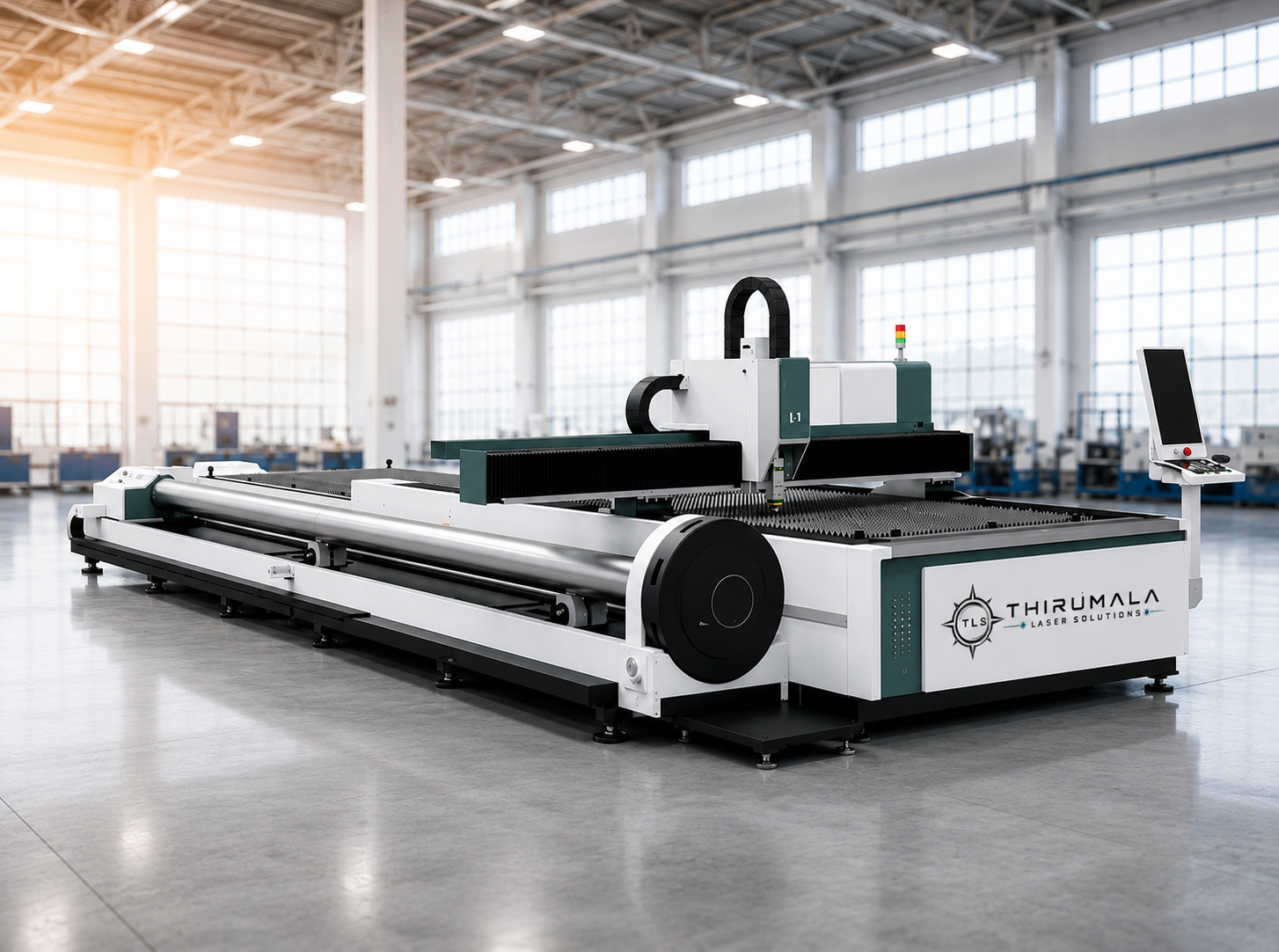
A 3 kW fiber laser cutting machine comfortably handles 12 mm mild steel, 6 mm stainless steel and 5 mm aluminium in production, with piercing times measured in tenths of a second. The same nominal power in a CO₂ machine will cut carbon steel well but slows sharply on stainless and struggles on aluminium and brass because those metals reflect the longer 10.6 micrometre beam.
On thin gauge — 0.8 mm to 3 mm sheet used in electrical panels, kitchen equipment, elevator cladding and automotive brackets — fiber cutting speeds are commonly two to four times higher than CO₂. That difference is what turns a two-shift bottleneck into a single-shift job for most Bangalore fabrication units.
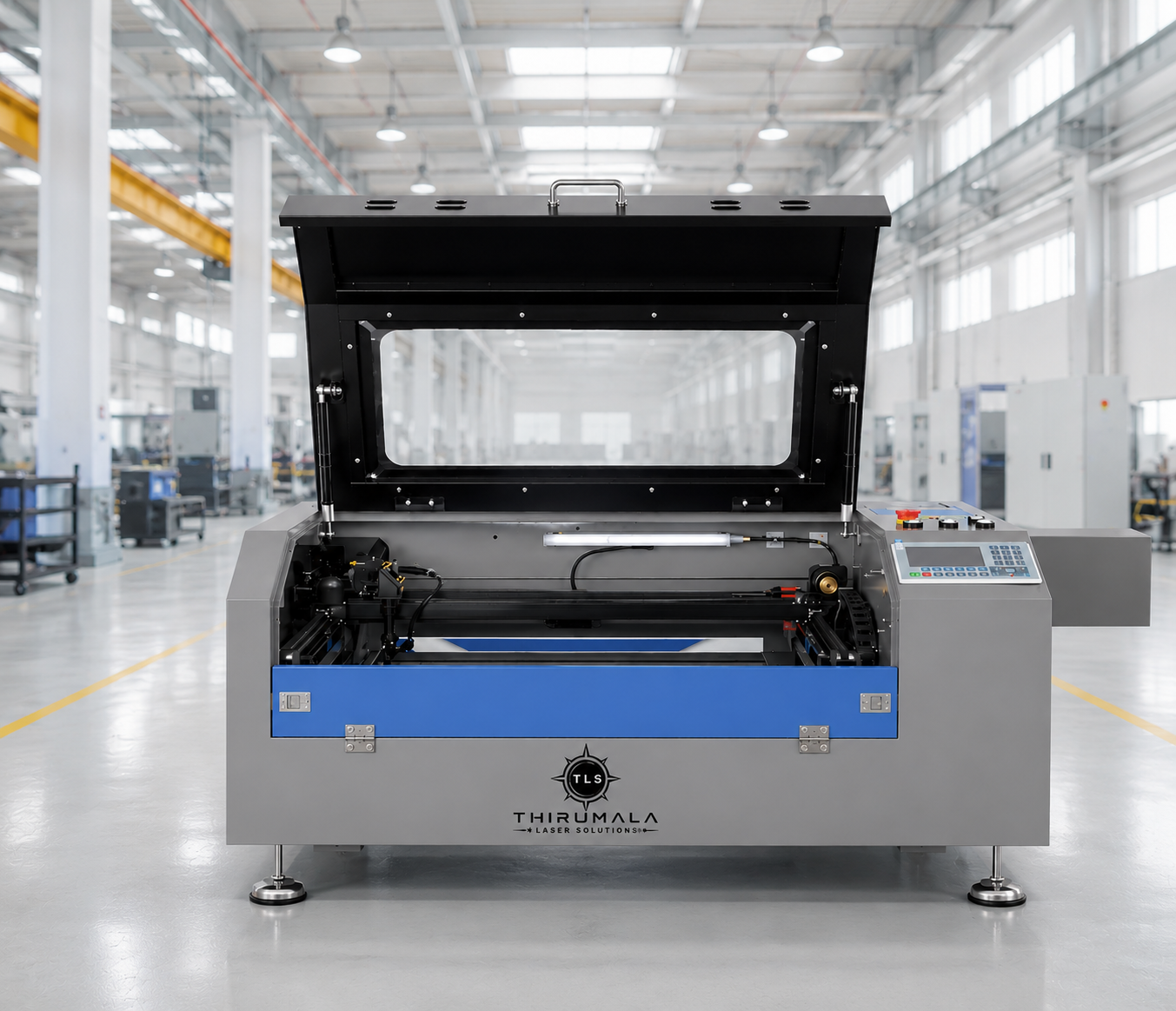
Where CO₂ still wins is non-metals: acrylic sheet above 8 mm, MDF, plywood, rubber gaskets, textiles and leather. If your order book mixes signage and metal, keep a CO₂ laser machine for the non-metal work and add a fiber cutter for everything metallic rather than forcing one machine to do both badly.
Maintenance, uptime and spare parts in Indian conditions
Dust, humidity and voltage fluctuation are the three realities of an Indian shop floor. A fiber source is sealed and has no mirrors in the beam path, so there is no weekly alignment ritual — the consumables you actually replace are the protective window, the nozzle and the ceramic ring. A CO₂ machine adds bellows, laser gas, tube replacement and a mirror path that needs alignment whenever the machine is shifted.
Plan for a stabiliser or servo voltage regulator, a clean compressed air line with a refrigerated dryer, and a small stock of protective windows and nozzles on the shelf. Those three items prevent the majority of unplanned downtime we see in the field.
We stock fiber laser spares in Bangalore and provide India-wide service response, so a consumable never becomes a week of lost production.
Total cost of ownership over five years
Compare machines on cost per cutting hour, not sticker price. Add electricity, assist gas (oxygen, nitrogen or clean dry air), consumables, chiller load, annual maintenance and expected downtime. A fiber cutter typically lands 30 to 50 percent lower per hour than an equivalent CO₂ machine on metal work, and the gap widens with every price rise in industrial power tariffs.
Nitrogen for oxide-free stainless edges is the biggest variable cost. Shops running high stainless volumes usually recover the price of an on-site nitrogen generator within 18 to 30 months.
Frequently asked questions
Can a fiber laser cut acrylic or wood? No. Those materials transmit rather than absorb the 1.07 micrometre wavelength, so you need a CO₂ laser for them.
How long does a fiber source last? Modern sources are rated around 100,000 hours of operating life, which is well beyond a decade of two-shift production.
Is a used CO₂ machine a good entry point? Only if your work is genuinely non-metal. For metal cutting, the running-cost penalty usually erases the savings inside two years.
Want a direct comparison on your own parts? Send a drawing or a sample and we will cut it on both technologies at our Bangalore facility so you can compare edge quality, cycle time and cost per part before you invest.